Family-owned lawn care and landscaping in Collinsville, IL. Fully insured.
Family-owned. Engineered for Illinois freeze-thaw cycles. Serving Collinsville, IL and 19 other Metro East cities.
Retaining Wall Installation in Collinsville, IL
Sanchez Lawnscape Services is a family-owned hardscape and landscape company offering retaining wall installation across Collinsville, IL and 19 surrounding Metro East communities. A properly built retaining wall holds soil, controls drainage, and adds usable terrace space to a sloped yard. A poorly built retaining wall fails within 5 years. This page walks through exactly how we install a retaining wall, what materials we recommend, and what your retaining wall project should cost.
How We Install a Retaining Wall, Step by Step
Building a retaining wall is a technical process. Done right, the wall lasts 30+ years. Done wrong, the wall bows, cracks, or collapses within a few seasons under hydrostatic pressure from wet soils. Here is the construction method we use on every retaining wall installation in Collinsville, IL.
Step 1: Site Plan and Wall Design
Every retaining wall project starts with a wall design. We mark the wall layout with a string line and stakes, confirming the desired height, length, and curve of the finished wall. For walls over 4 feet in height, an engineer's stamp may be required by local code. We also call 811 to check for utility lines beneath the proposed wall site before excavation, because the change in pressure from the wall could potentially damage these lines.
Step 2: Excavation and the Base Trench
Excavation for a retaining wall should involve removing all surface vegetation and debris, and the base trench should be excavated to the designed width and depth, which typically varies depending on the block style and wall design. We dig the base trench wider than the block to allow for proper compaction, and deeper than the first course of block so the buried base provides stability. Loose, sloppy excavation is the #1 reason DIY retaining walls fail.
Step 3: Base Course and Base Material
The base course is the foundation that everything sits on. We lay a 6-inch layer of compacted base material, typically crushed gravel — and use a hand tamper or plate compactor to lock it in place. The first course of block sits directly on this base material. Every block in the first row gets leveled side to side and front to back with small adjustments before the next course goes in. The first course determines the alignment of the entire wall, so this step is extremely important.
Step 4: Stacking Additional Courses
Once the first row is set, we stack additional courses one row at a time. Each next course is offset from the one below (a running bond pattern) so the joints don't line up vertically. Block-style retaining wall blocks have a built-in lip that locks each course into the next, but we also apply concrete adhesive on the last course and any decorative cap blocks for added strength.
Step 5: Backfill, Drainage Pipe, and Landscape Fabric
Behind the wall, drainage is what separates a 30-year wall from a 3-year wall. We install a perforated drainage pipe along the base behind the wall to carry water away. Landscape fabric goes between the backfill material and the native soil to prevent fine particles from clogging the drainage. Backfill is added in 6-inch lifts of additional gravel and compacted as we go, never dumped in all at once.
Step 6: Final Layer and Cap
The final layer of backfill is topsoil, sloped slightly away from the wall to direct surface water away. Cap blocks are glued to the top course with concrete adhesive for a finished look that also seals the hollow cores of any block underneath, keeping water out of the wall structure.
Materials We Use for Retaining Wall Installation
The most recommended materials for retaining walls in Collinsville are engineered interlocking concrete blocks and natural stone due to their durability against local weather conditions. Illinois freeze-thaw cycles destroy walls built with the wrong materials. Here is what we use.
Engineered Interlocking Concrete Blocks
Stackable concrete blocks are commonly used for constructing retaining walls, featuring designs that resemble hand-hewn stone or aged masonry, and include groove-and-lip systems for self-aligning installation. We typically install Versa-Lok, Pavestone, or Belgard wall blocks depending on what's available locally and what design fits your home. Retaining wall blocks are durable, freeze-thaw rated, and engineered for proper structural reinforcement.
Natural Stone
For a more organic look, natural stone retaining walls (limestone, sandstone, or fieldstone) blend into landscaping and never look dated. Natural stone installation costs more per square foot but lasts indefinitely with proper drainage. Best for shorter walls and decorative garden walls.
Timber and Railroad Tie Walls (Not Recommended)
We do not install pressure-treated timber or railroad tie retaining walls. They look fine for 5 to 7 years and then rot, lean, or pull away from anchors. Many Metro East homes have aging timber walls that need replacement. We replace them with engineered block walls that last 5x longer.
Retaining Wall Pricing in Collinsville, IL
Detailed written estimates should include the type of block, total square footage, and separate itemization of costs such as excavation and delivery. Our quotes break down every line item so you know exactly what you are paying for. Here are the ranges for a typical retaining wall project.
Standard Block Walls
A standard engineered block retaining wall in the Metro East runs $30 to $55 per face square foot installed, including excavation, base material, blocks, drainage pipe, landscape fabric, backfill, and cap blocks. A 4-foot tall wall 20 feet long is roughly 80 square feet, or $2,400 to $4,400 installed. Most residential retaining wall projects fall between $3,000 and $8,500.
Natural Stone Walls
Natural stone retaining walls run $50 to $100 per face square foot installed because stone is heavier, harder to source, and requires more skilled labor. Most natural stone walls fall between $5,000 and $15,000 for residential projects.
What Affects Retaining Wall Pricing
Lot access (can a skid steer reach the wall location?), excavation depth and soil conditions, wet soils or high water table, wall height (over 4 feet typically requires engineered design), and finish details like cap blocks, decorative stone face, or built-in stairs. We walk through all of this on the quote so there are no surprises after work starts.
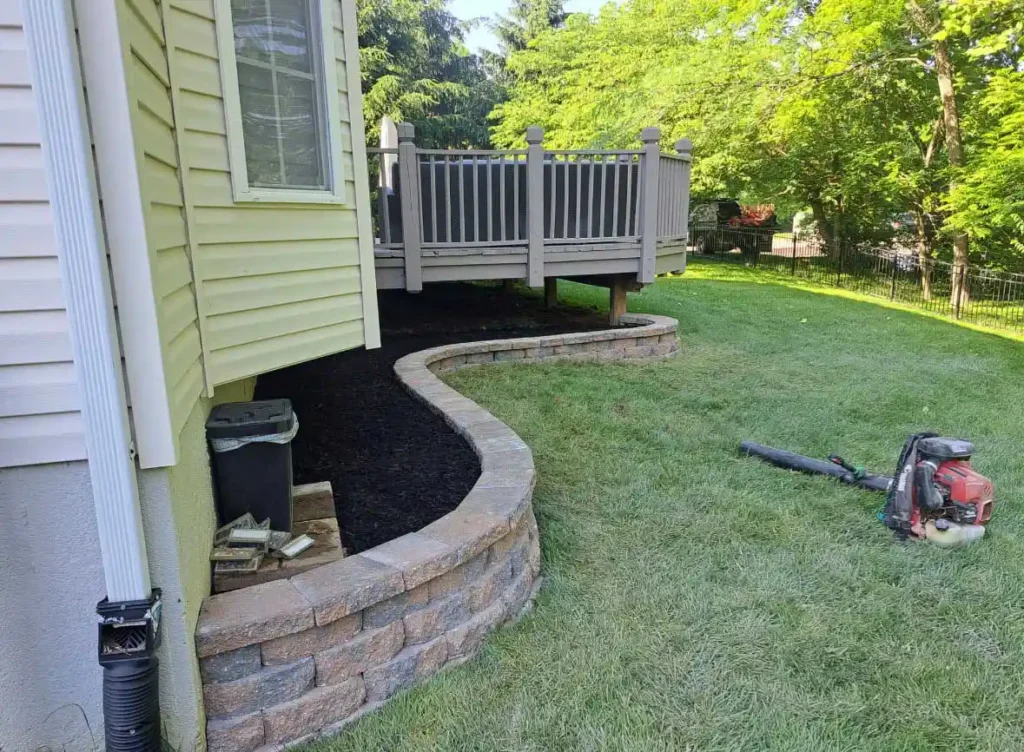
Before
After
Why Hire a Local Family-Owned Retaining Wall Contractor
Building retaining walls is one of the most technical landscape projects a homeowner can take on. The materials are heavy, the construction methods are unforgiving, and small mistakes compound into expensive failures. Here is why most Collinsville, IL homeowners hire it out.
Engineering and Code
Walls over 4 feet in height typically require engineered drawings and may need permits. We handle the engineering coordination and permit application as part of the retaining wall installation. Most DIY builders skip this and end up with code violations or insurance issues if the wall fails.
Equipment and Material Sourcing
A retaining wall project needs a skid steer for excavation, a plate compactor for the base course, a wet saw for cutting blocks, and a way to deliver pallets of wall blocks. Renting all of that for a weekend costs more than hiring a crew that owns it. Plus we get contractor pricing on retaining wall blocks, drainage pipe, base material, landscape fabric, and concrete adhesive that homeowners cannot match.
Drainage Engineering
The most common reason a retaining wall fails is poor drainage behind the wall. Hydrostatic pressure from wet soils pushes the wall outward until it bows or collapses. Every Sanchez retaining wall includes proper drainage pipe, gravel backfill, and landscape fabric installed correctly the first time.
Local Knowledge of Collinsville, IL Soils
Collinsville sits on silt loam over clay subsoil. That matters for retaining walls because clay holds water and freezes hard in winter. Our base course depth and drainage design accounts for local soil conditions. National contractors using the same playbook for every state get this wrong.
Frequently Asked Questions About Retaining Wall Installation
How much does a retaining wall cost in Collinsville, IL?
Most residential retaining wall projects in Collinsville, IL fall between $3,000 and $8,500 for engineered block walls, and $5,000 to $15,000 for natural stone. Pricing is $30 to $55 per face square foot for block, $50 to $100 for stone. Excavation, drainage, and cap blocks are included in every Sanchez quote.
How long does retaining wall installation take?
Most residential retaining wall projects are completed in 3 to 7 days depending on wall length, height, and site access. Larger projects with engineering review can take 2 to 3 weeks from quote to finished wall.
Do you offer free estimates for retaining walls?
Yes. We provide free written estimates that include type of block, total square footage, excavation, base material, drainage pipe, landscape fabric, backfill, cap blocks, and labor as separate itemized line items. Quotes are good for 30 days.
Do I need a permit for a retaining wall?
Walls under 4 feet in height typically do not require permits in most Metro East municipalities. Walls over 4 feet usually do. We handle permit application and engineering as part of the retaining wall installation when required.
What is the best retaining wall material?
For Collinsville, IL conditions, engineered interlocking concrete blocks (Versa-Lok, Pavestone, Belgard) offer the best mix of durability, cost, and finish. Natural stone is the premium option. We do not recommend timber or railroad tie walls because they fail within 5 to 7 years in our climate.
What if my old retaining wall is failing?
We replace failing timber, railroad tie, or improperly built block walls regularly. The old wall and backfill come out, drainage gets reinstalled correctly, and a new engineered wall goes in. Replacement projects are quoted the same way as new installs.
What cities do you serve for retaining wall installation?
We serve 20 communities across the Metro East: Collinsville, Alton, Belleville, Caseyville, Columbia, Edwardsville, Fairview Heights, Glen Carbon, Godfrey, Granite City, Lebanon, Maryville, Mascoutah, Millstadt, O'Fallon, Shiloh, Swansea, Troy, Waterloo, and Wood River.
Ready to Build a Retaining Wall That Lasts?
Tell us about your project. We provide free written estimates, engineering coordination, and a finished wall that holds the slope for decades. Call (618) 560-3313 or use the quote form for a same-day response.
Lawn Care & Landscaping Services Across 20 Metro East Communities in IL.
Collinsville, IL
Alton, IL
Belleville, IL
Caseyville, IL
Columbia, IL
Edwardsville, IL
Fairview Heights, IL
Glen Carbon, IL
Godfrey, IL
Granite City, IL
Lebanon, IL
Maryville, IL
Mascoutah, IL
Millstadt, IL
O'Fallon, IL
Shiloh, IL
Swansea, IL
Troy, IL
Waterloo, IL
Wood River, IL
Not sure if you are inside our service area? Call (618) 560-3313 or message us and we will let you know.